Text de l'enunciat
3. Imagine you’ve gone to one of the immersion shows described in the Reading comprehension text (Part 2). Write an email to a friend in which you explain the experience and suggest you both go together in the near future.
Grammar
Vocabulary
Text
Maturity
Total
Nota de la redacció
Etiqueta de l’alumne/a
L’Institut d’Estudis Catalans ha tingut cura de la correcció lingüística i de l’edició d’aquesta prova d’accés
2023
Proves d’accés a la universitat
Llengua estrangera Anglès
Sèrie 5 - A
Quadre de qu al ificaci
Espai per etiquetes
Part 1: Listening comprehension
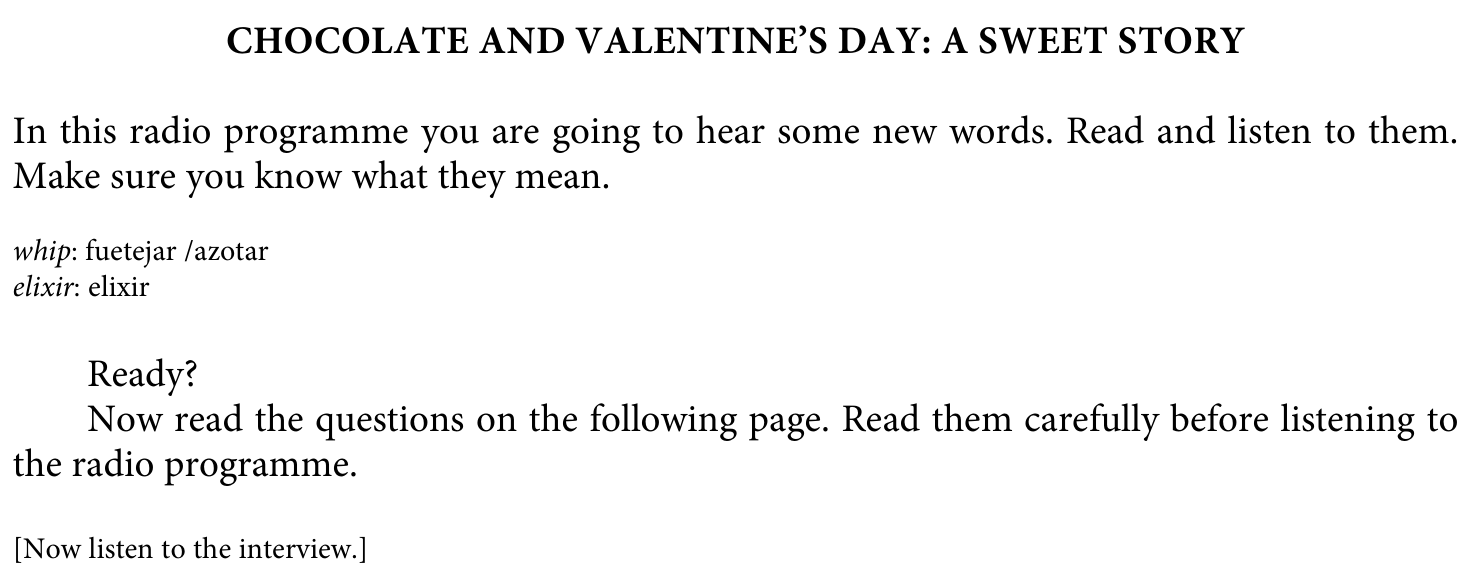
CHOCOLATE AND VALENTINE’S DAY: A SWEET STORY
In this radio programme you are going to hear some new words. Read and listen to them. Make sure you know what they mean.
whip: fuetejar /azotar elixir: elixir
Ready? Now read the questions on the following page. Read them carefully before listening to the radio programme.
[Now listen to the interview.]
QUESTIONS
Choose the best answer according to the recording. Only ONE answer is correct.
[3 points: 0.375 points for each correct answer. Wrong answers will be penalized by deducting 0.125 points. There is no penalty for unanswered questions.]
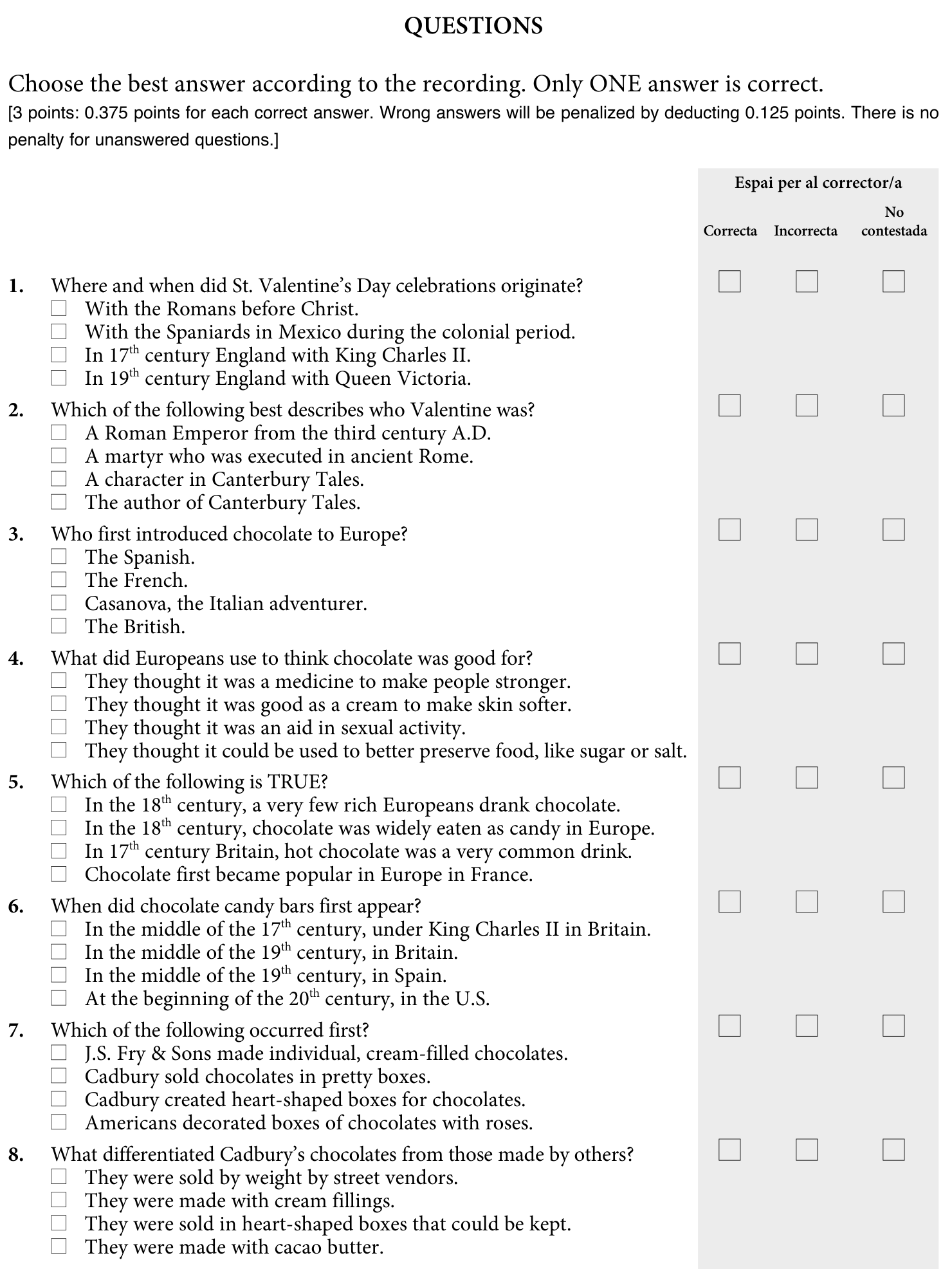
1. Where and when did St. Valentine’s Day celebrations originate?
With the Romans before Christ. With the Spaniards in Mexico during the colonial period. In 17^(th) century England with King Charles II. In 19^(th) century England with Queen Victoria. 2. Which of the following best describes who Valentine was?
A Roman Emperor from the third century A.D. A martyr who was executed in ancient Rome. A character in Canterbury Tales. The author of Canterbury Tales. 3. Who first introduced chocolate to Europe?
The Spanish. The French. Casanova, the Italian adventurer. The British. 4. What did Europeans use to think chocolate was good for?
They thought it was a medicine to make people stronger. They thought it was good as a cream to make skin softer. They thought it was an aid in sexual activity. They thought it could be used to better preserve food, like sugar or salt. 5. Which of the following is TRUE?
In the 18^(th) century, a very few rich Europeans drank chocolate. In the 18^(th) century, chocolate was widely eaten as candy in Europe. In 17^(th) century Britain, hot chocolate was a very common drink. Chocolate first became popular in Europe in France. 6. When did chocolate candy bars first appear?
In the middle of the 17^(th) century, under King Charles II in Britain. In the middle of the 19^(th) century, in Britain. In the middle of the 19^(th) century, in Spain. At the beginning of the 20^(th) century, in the U.S. 7. Which of the following occurred first?
J.S. Fry & Sons made individual, cream-filled chocolates. Cadbury sold chocolates in pretty boxes. Cadbury created heart-shaped boxes for chocolates. Americans decorated boxes of chocolates with roses. 8. What differentiated Cadbury’s chocolates from those made by others?
They were sold by weight by street vendors. They were made with cream fillings. They were sold in heart-shaped boxes that could be kept. They were made with cacao butter.
Espai per al corrector/a
No Correcta Incorrecta contestada
Correctes Incorrectes No contestades
Recompte de les respostes
Part 2: Reading comprehension
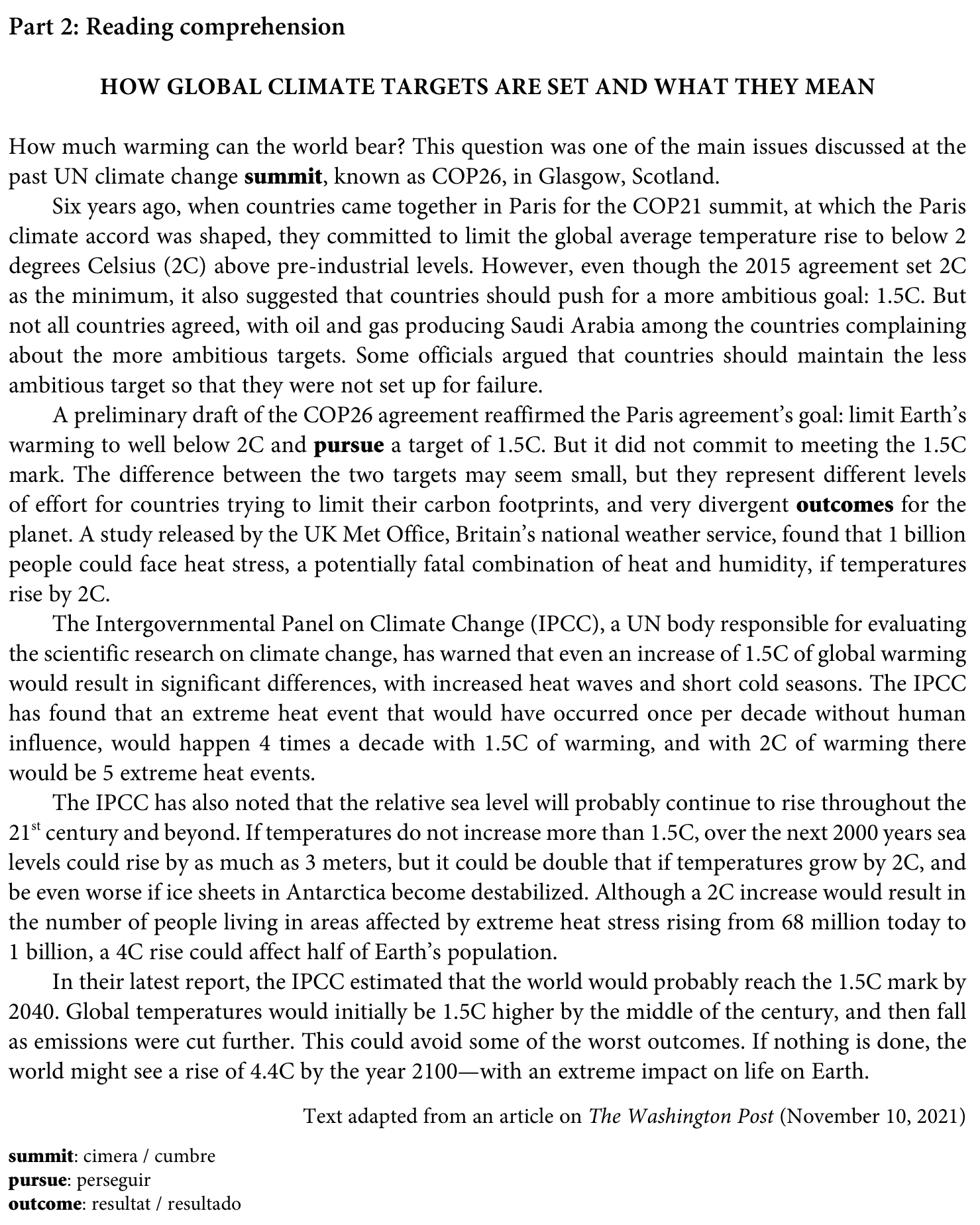
HOW GLOBAL CLIMATE TARGETS ARE SET AND WHAT THEY MEAN
How much warming can the world bear? This question was one of the main issues discussed at the past UN climate change summit, known as COP26, in Glasgow, Scotland.
Six years ago, when countries came together in Paris for the COP21 summit, at which the Paris climate accord was shaped, they committed to limit the global average temperature rise to below 2 degrees Celsius (2C) above pre-industrial levels. However, even though the 2015 agreement set 2C as the minimum, it also suggested that countries should push for a more ambitious goal: 1.5C. But not all countries agreed, with oil and gas producing Saudi Arabia among the countries complaining about the more ambitious targets. Some officials argued that countries should maintain the less ambitious target so that they were not set up for failure.
A preliminary draft of the COP26 agreement reaffirmed the Paris agreement’s goal: limit Earth’s warming to well below 2C and pursue a target of 1.5C. But it did not commit to meeting the 1.5C mark. The difference between the two targets may seem small, but they represent different levels of effort for countries trying to limit their carbon footprints, and very divergent outcomes for the planet. A study released by the UK Met Office, Britain’s national weather service, found that 1 billion people could face heat stress, a potentially fatal combination of heat and humidity, if temperatures rise by 2C.
The Intergovernmental Panel on Climate Change (IPCC), a UN body responsible for evaluating the scientific research on climate change, has warned that even an increase of 1.5C of global warming would result in significant differences, with increased heat waves and short cold seasons. The IPCC has found that an extreme heat event that would have occurred once per decade without human influence, would happen 4 times a decade with 1.5C of warming, and with 2C of warming there would be 5 extreme heat events.
The IPCC has also noted that the relative sea level will probably continue to rise throughout the 21^(st) century and beyond. If temperatures do not increase more than 1.5C, over the next 2000 years sea levels could rise by as much as 3 meters, but it could be double that if temperatures grow by 2C, and be even worse if ice sheets in Antarctica become destabilized. Although a 2C increase would result in the number of people living in areas affected by extreme heat stress rising from 68 million today to 1 billion, a 4C rise could affect half of Earth’s population. In their latest report, the IPCC estimated that the world would probably reach the 1.5C mark by 2040. Global temperatures would initially be 1.5C higher by the middle of the century, and then fall as emissions were cut further. This could avoid some of the worst outcomes. If nothing is done, the world might see a rise of 4.4C by the year 2100—with an extreme impact on life on Earth.
Text adapted from an article on The Washington Post (November 10, 2021) summit: cimera / cumbre pursue: perseguir outcome: resultat / resultado
QUESTIONS
Choose the best answer according to the text. Only ONE answer is correct.
[3 points: 0.375 points for each correct answer. Wrong answers will be penalized by deducting 0.125 points. There is no penalty for unanswered questions.]
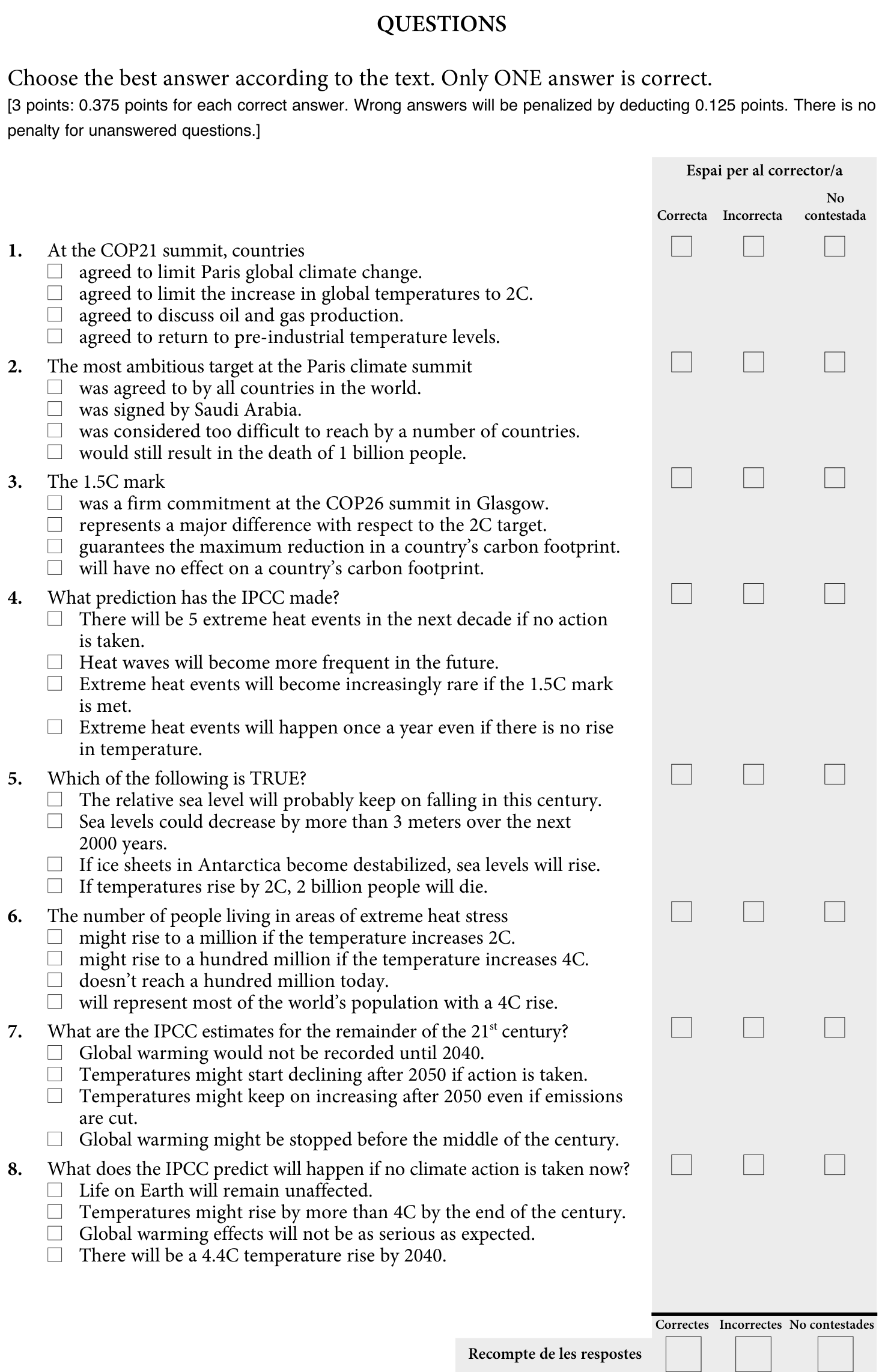
1. At the COP21 summit, countries agreed to limit Paris global climate change. agreed to limit the increase in global temperatures to 2C. agreed to discuss oil and gas production. agreed to return to pre-industrial temperature levels. 2. The most ambitious target at the Paris climate summit was agreed to by all countries in the world. was signed by Saudi Arabia. was considered too difficult to reach by a number of countries. would still result in the death of 1 billion people. 3. The 1.5C mark was a firm commitment at the COP26 summit in Glasgow. represents a major difference with respect to the 2C target. guarantees the maximum reduction in a country’s carbon footprint. will have no effect on a country’s carbon footprint. 4. What prediction has the IPCC made?
There will be 5 extreme heat events in the next decade if no action is taken. Heat waves will become more frequent in the future. Extreme heat events will become increasingly rare if the 1.5C mark is met. Extreme heat events will happen once a year even if there is no rise in temperature. 5. Which of the following is TRUE?
The relative sea level will probably keep on falling in this century. Sea levels could decrease by more than 3 meters over the next
2000 years. If ice sheets in Antarctica become destabilized, sea levels will rise. If temperatures rise by 2C, 2 billion people will die. 6. The number of people living in areas of extreme heat stress might rise to a million if the temperature increases 2C. might rise to a hundred million if the temperature increases 4C. doesn’t reach a hundred million today. will represent most of the world’s population with a 4C rise. 7. What are the IPCC estimates for the remainder of the 21^(st) century?
Global warming would not be recorded until 2040. Temperatures might start declining after 2050 if action is taken. Temperatures might keep on increasing after 2050 even if emissions are cut. Global warming might be stopped before the middle of the century. 8. What does the IPCC predict will happen if no climate action is taken now?
Life on Earth will remain unaffected. Temperatures might rise by more than 4C by the end of the century. Global warming effects will not be as serious as expected. There will be a 4.4C temperature rise by 2040.
Espai per al corrector/a
No Correcta Incorrecta contestada
Correctes Incorrectes No contestades
Recompte de les respostes
Part 3: Writing
Choose ONE topic. Your answer should be 125-150 words in length. There is no specific penalty for exceeding 150 words in length. Extra points are not given for exceeding 150 words.
[4 points]
Tret automàticament del PDF oficial: les fórmules es veuen bé a la imatge.